We've stayed quiet about a token on purpose. Plenty of projects ship a coin first and figure out why it should exist later. We wanted the product working and the mechanics honest before we put a token anywhere near it. Here is the plan.
The idea in one line
Launch a token everyone buys at the same price, give it a real reason to hold, and slowly shrink the supply over time using the platform's own trading fees, in a way that can never burn the whole thing to zero.
No presale. No private round. No team allocation sitting in a wallet waiting to dump on you. We launch it on Clanker, a fair-launch platform on Base, where the entire supply goes straight into the open market and the price discovers itself from there.
How the launch works
A few specifics, because the details are what make it fair.
- Fixed supply of 100 billion tokens. That is Clanker's standard. We never mint more. There is no inflation knob.
- A low starting market cap, around $10K. We start small on purpose. A low cap means early supporters get in cheap and there is real room to grow, instead of launching at a number only insiders could love.
- We take the first buy, not the bots. At launch the team buys a chunk at the same opening price as everyone else, and we turn on Clanker's sniper protection so automated bots cannot front-run the launch and scalp the cheap tokens. Humans get a fair shot, not MEV bots.
- A 1% trading fee funds everything. Every swap on the token pays a 1% fee. Clanker takes 20% of that, so we keep roughly 0.8% of all trading volume. That fee stream is what pays for the buy-and-burn below. We never sell tokens to fund the project. The fees do that.
What the token is for
We are launching with two concrete reasons to hold, both wired straight into the product.
One: hold the token, earn more when you create markets. On 5050, when a market you created resolves, you earn a cut of it. Normally that is 5%. If you are holding enough $5050, it becomes 10% instead. The check that keeps it honest is that we look at whether you are holding at the moment the market settles, so you cannot buy, create a market, dump the token, and still collect the bonus. You have to actually be a holder when it pays out. And the extra 5% does not come out of anyone else's pocket, not the winners and not other traders. It comes out of our platform share. We cover the cost of rewarding holders ourselves, on purpose, so it is a real benefit that does not quietly tax the rest of the users to pay for it.
Two: holders get early access. New features land for token holders first before they roll out to everyone. If you hold, you are on the inside of what we ship next.
We would rather launch with two benefits that are real than ten that are vague, so we are starting here and will add more as the product grows.
The burn: shrink the supply, but never to zero
This is the mechanism we are most careful about.
Every week we take a slice of the trading fees the token earns, use it to buy $5050 on the open market, and burn what we buy. Buying and burning takes tokens out of circulation permanently. Fewer tokens against the same demand is the simple story people like, and because the money comes from real trading fees, the burn is funded by usage rather than by us printing or selling anything.
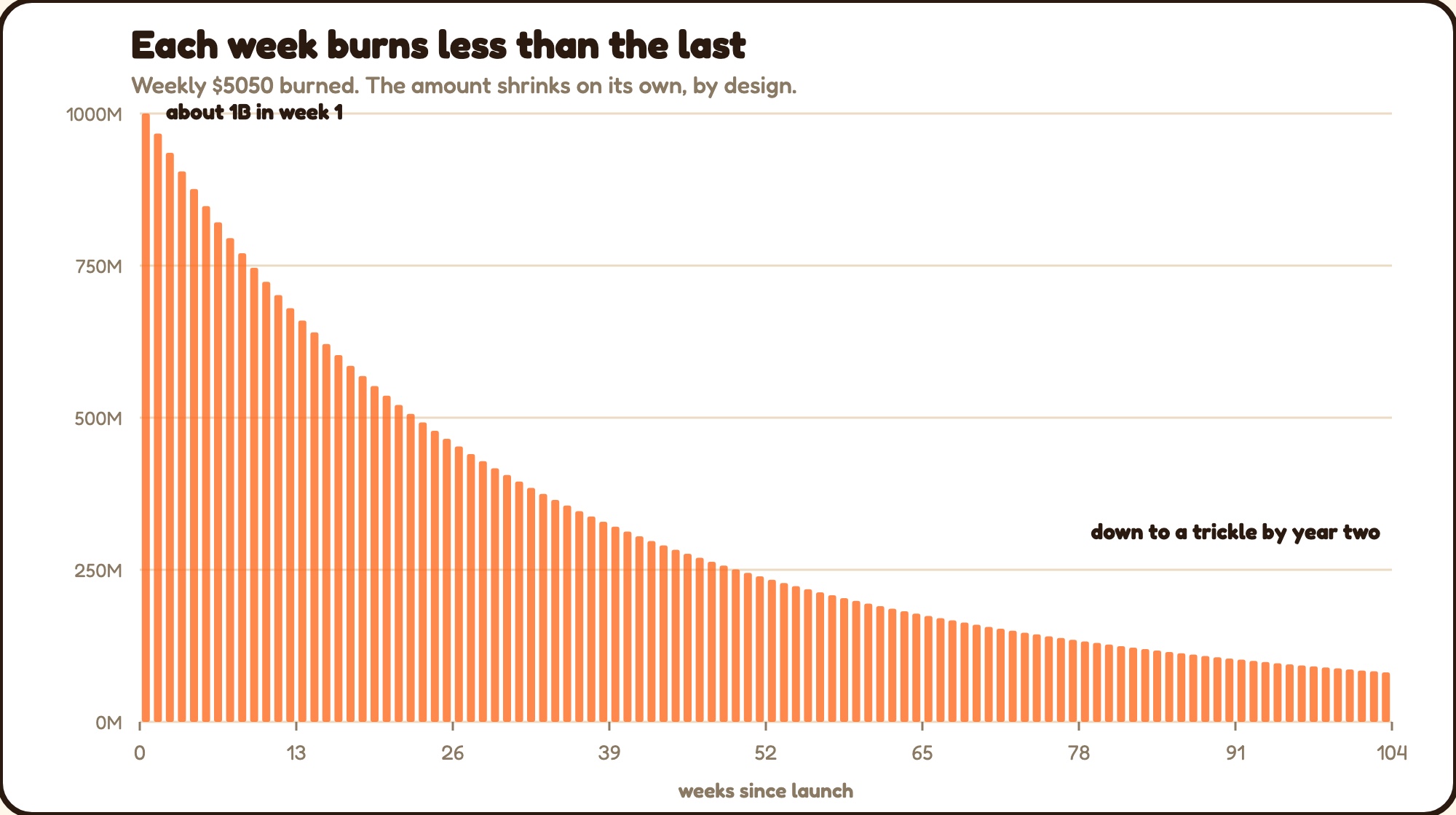
The careful part is deciding how much to burn. The naive version, burning a fixed number of tokens every week, marches the supply straight to zero eventually. So we do not do that. Instead, each week we target a small percentage of the supply that is still left, above a floor we never cross. As the supply shrinks, that percentage is a smaller and smaller number, so the burn slows down on its own.
Two things make it taper instead of run away:
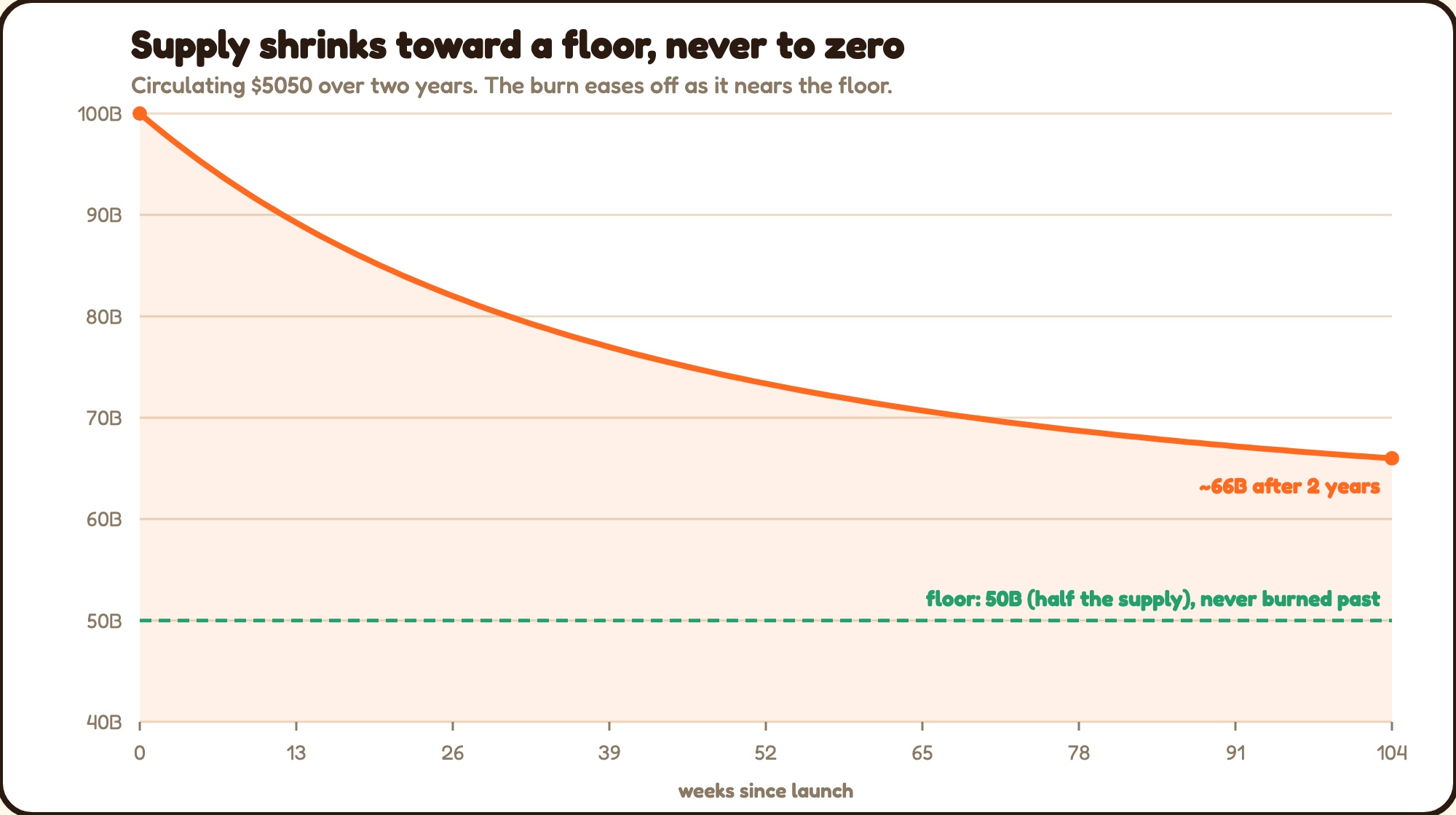
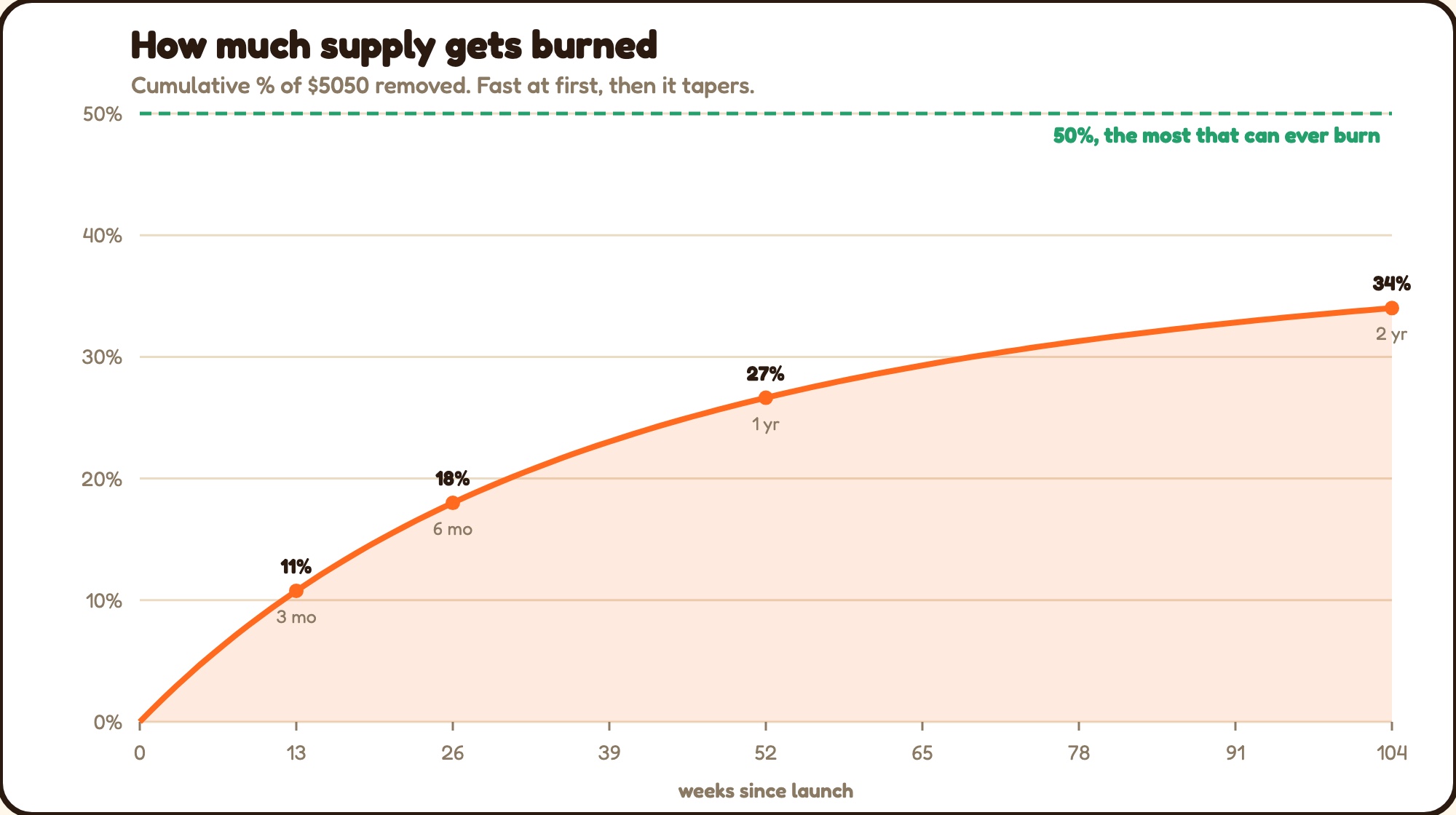
- A floor we never burn past. We pick a minimum, say half the supply, and the burn only ever nibbles at the gap above it. As the supply approaches the floor, the weekly burn shrinks toward nothing. It cannot cross the line.
- The rate itself fades over time. The burn is aggressive early, which is when the deflation story matters most, and gentler later.
Here is what that looks like over two years, using a deliberately conservative example: a small token starting at a $10K cap, doing around $250K of trading volume a week, with us pointing 10% of the fees at the burn.
The supply glides toward a floor and stops, so it never approaches zero.
Each week burns less than the week before, automatically.
And the total stays capped. In this example about a third of the supply is gone after two years, and by design it can never pass the floor, so the most that could ever burn is half.
To start, we will run the burns by hand and publish a simple, public counter so anyone can verify exactly what has been bought and burned. No black box. If it earns trust, we automate it later.
The honest part: assumptions
The charts above are a model, not a forecast, and two of the inputs are assumptions about how the token performs rather than dials we control.
- It all rides on real trading volume. The fees that fund the burn, and our income, scale directly with how much the token actually trades. At healthy volume the plan works as drawn. At low volume the fee stream is small, the burn is small, and not much happens. The burn is downstream of people actually using and trading the token, and we are not going to pretend otherwise.
- We assumed a modestly rising price. If the token does well, the same fee dollars buy fewer tokens, so the burn naturally slows, which is fine. If it does badly, the fees shrink with it. The model is a decent-traction scenario, not a guarantee.
So treat the specific percentages as illustration. What we are committing to is the shape: a fair launch, fees that fund a buy-and-burn, a burn that decelerates and is capped by a floor, and holding that earns real in-product benefits we pay for ourselves.
Why we think this is fair
Stack it up:
- Everyone buys at the same price. No insiders, no presale, no team bag.
- The token earns its keep from real trading fees, not from us dumping supply.
- Holding gives concrete benefits, and we cover the cost of those benefits instead of charging other users for them.
- The burn shrinks supply for holders but can never zero it out, and it is transparent from day one.
One more thing
This is a plan, not a final spec. Everything here, including the floor, how fast the burn tapers, the share of fees we point at it, and the exact amount you need to hold, can still change before launch. We will publish the locked version once it is set.
Play 5050 →